They didn’t start playing the national anthem at sporting events regularly until around 1941.
In 1916, President Wilson ordered that “The Star-Spangled Banner” be played at military and other appropriate occasions. There were never any Presidential orders to play the anthem at sporting events. Football, as it appears, has nothing to do with our Military, or anything else to do with the defense of our country at all. This whole business of taking a knee at a football game is rather meaningless when you put our Anthem and our Flag into it’s proper perspective.
The NFL is absolutely “not” a government organization.
The NFL is a private, for profit entertainment venue similar to Seinfeld – How many times did they play the National Anthem before Will and Grace came on? How many times did they play the National Anthem before Gilligan’s Island came on?
See how that works? The NFL is a simple entertainment venue that’s not too unlike the shows mentioned above and has nothing to do with our government or it’s overall national security.
Kneeling before a football game to protest something is just like kneeling to protest something before The Simpsons come on. The eventual outcome of doing each would be the same. Save for the effects of attempted social engineering, it’s all pretty pointless and does absolutely nothing to further the cause of anyone.
Mixing politics with entertainment can only show just how far down the rabbit hole we’ve gone.
The NFL has done more to protest America in the past few years than it has ever done to try and eliminate the domestic violence committed by its own players. Players crying about being marginalized, while at the same time being allowed to marginalize someone else with impunity is somewhat of a stretch, don’t you think?
As far as the national anthem is concerned, why not just play it at only government related functions. Doing that might keep these so-called protests away from our entertainment industry, and put the racism argument directly into the middle of the government political arena where it belongs in the first place.
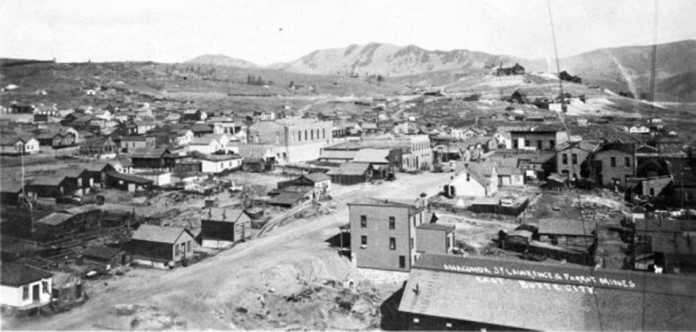
The Berkeley Pit is a former open pit copper mine in Butte, Montana. Approximately 320 million tons of ore and over 700 million tons of waste rock were mined from the Butte Hill.
The mine was opened in 1955 and operated by the Anaconda Copper Mining Company, and later by the Atlantic Richfield Company (ARCO), until its closure on Earth Day in 1982. When the pit was closed, the water pumps in the nearby Kelley Mine, 3,800 feet below the surface, were turned off, and groundwater from the surrounding aquifers began to slowly fill the Berkeley Pit, rising at about the rate of one foot a month. Since its closure in 1982, the water level in the pit has risen to within 150 feet of the natural water table.
Today the Berkeley Pit has become a symbol of dark tourism. People stop to take pictures and take in the effects of humans on the environment.
It’s not the most glamorous attraction in Butte, but it’s one of the only places in the world where you can pay to see toxic waste.
Admission is $2 per person to see “51 billion gallons of arsenic, lead, and cadmium-laced liquid,” Justin Nobel wrote on Topic.
The Pit measures more than a mile long and a half-mile wide, and is currently a 1,085-foot-deep deposit of toxic water, and it’s rising about seven feet each year. By 2023, the water is expected to overflow, break its bedrock, and seep into Butte, contaminating the drinking water.
Well it appears that the flu season is once again upon us and healthcare officials are encouraging everyone to be vaccinated.
Most heed the warnings and notices and head right out to get their flu shots.
But what if you followed all of the advice and did everything by the book and still caught the flu? Does it mean that your vaccination was bogus? Did health officials lie?
Well, not exactly.
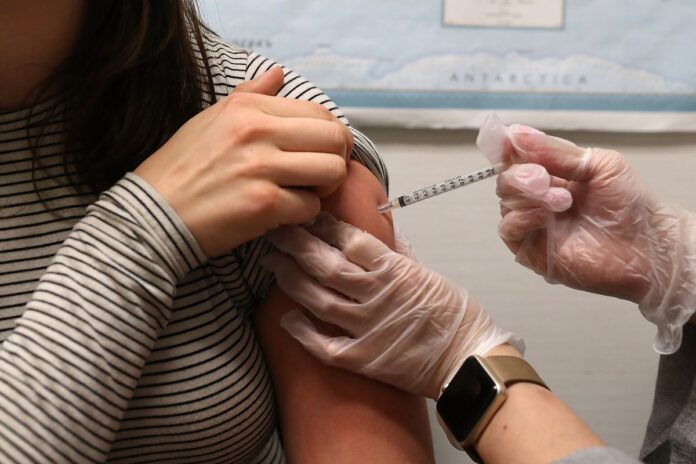
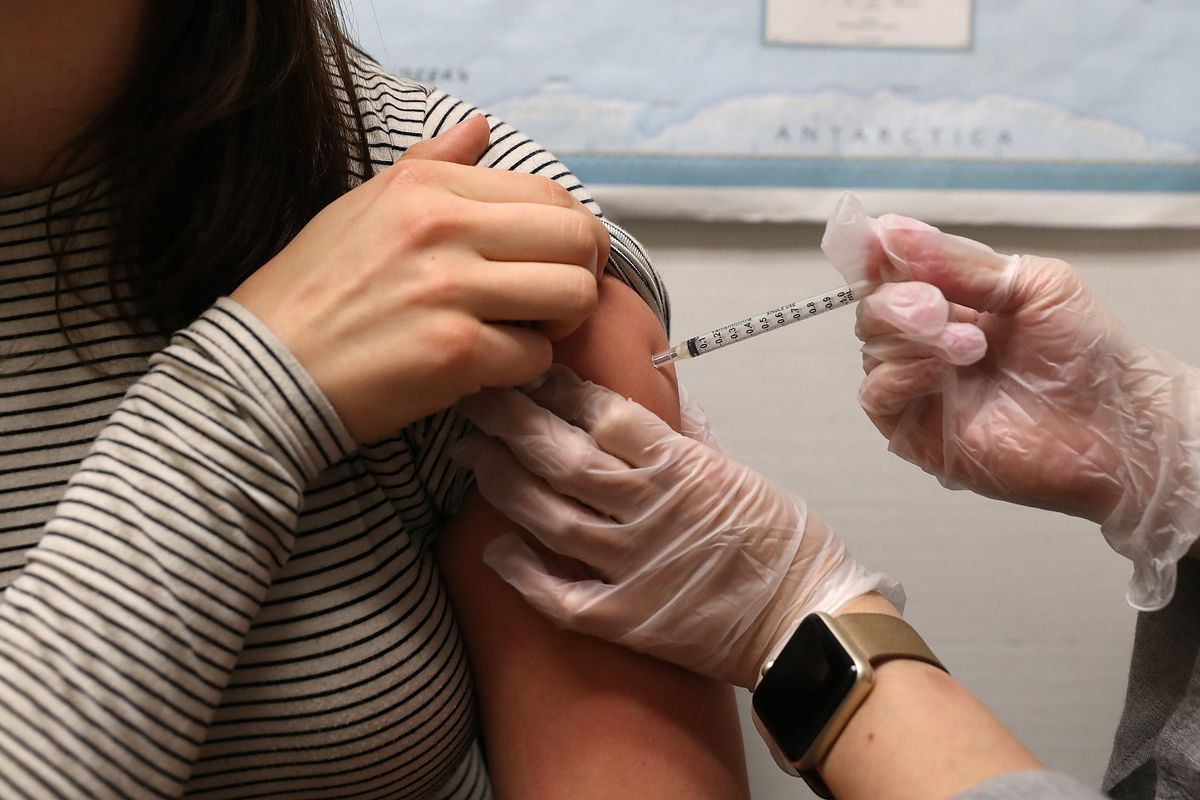
Flu vaccine administered (tap or click on image to enlarge)
You see, there are many different variations of what we have come to know as the “flu” — The “flu”, over the years, has been used to describe nearly anything that might cause us to not feel well, and generally speaking, the flu does seem to cover quite a bit when you stop to consider just how many strains and sub-strains of the flu there actually are.
The flu, or Influenza, as it’s commonly referred to in medical circles, comes in three main types:
Among these main types are what we like to call sub-types, or subdivisions.
The influenza A virus, for instance, can be subdivided into different serotypes based on the type of hemagglutinin and neuraminidase. The “H” in “H1N1” for example refers to hemagglutinin (HA) and “N” in “H1N1” refers to neuraminidase (NA). There are 16 different types of HA and 9 different types of NA, therefore, there are potentially 144 different sub-types of influenza A viruses.
Among them, two sub-types of influenza A, H1N1 and H3N2, most commonly infect humans. For each sub-type virus, the hemagglutinin gene mutates all the time and hence there are many variants of the same sub-type viruses, and hence the need to change the virus strain for seasonal flu vaccines on an annual basis.
So you got your flu shot and you still got sick.
Since there are so many different sub-types, or subdivisions of just the type A virus, a lot of work goes into determining just which vaccine should be used for the upcoming flu season. Health officials usually do a pretty good job of getting it right, but sometimes, even with all of their combined calculative effort, it can still come out wrong. The right vaccine could have been selected for the season only to have the strain change or drift before the start of flu season.
And so maybe this year health officials got it right, but you just ended up with a strain that wasn’t covered in the vaccine you received. Maybe your version of the flu had drifted a little before the season started.
The flu virus in and of itself is a constantly evolving thing. Pitching and yawing tither and yon on a seemingly monthly basis. Coming up with a new or different vaccine every year might remind some of us of that whack-a-mole game we like to play at the county fair, although getting to a right vaccine is somewhat more scientific.
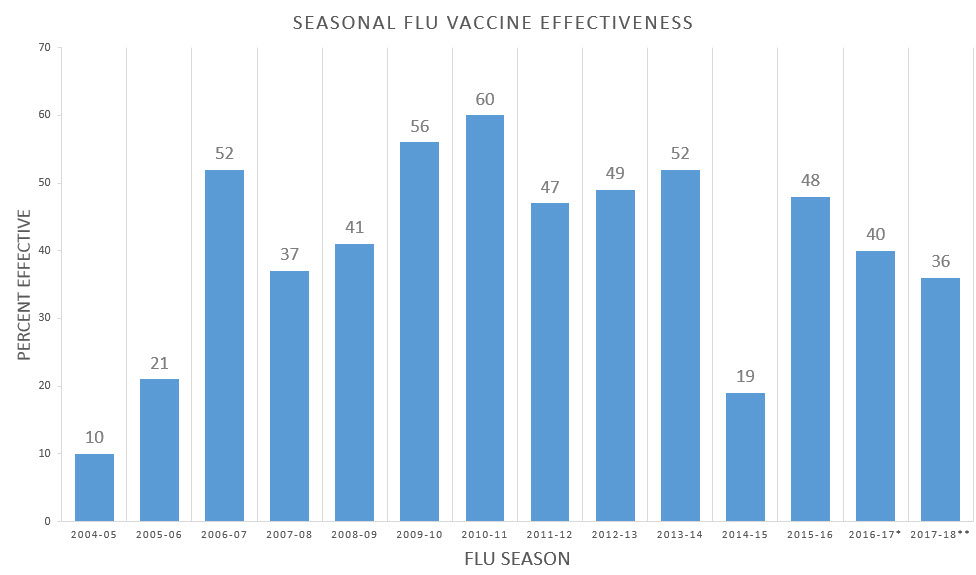
Seasonal flu vaccine effectiveness (tap or click on image to enlarge)
The average rate of effectiveness of any annual vaccine can range anywhere between 37% to 60% — You may have noticed the large swing in percentages, or most notably the lowest percentage. There isn’t just one single reason for the swings in statistics.
When you stop and consider the variants, or subdivisions related to just the Influenza A virus itself, and then pile on all of the millions of people who never wash their hands, or who never cover their mouth when they cough or sneeze, or as a general rule fail to practice every day personal hygiene, one might come away with the notion of just how good these statistics actually do look.
Our medical professionals aren’t gods or miracle workers by any stretch – They are just a cog in your every day wheel of health — Your health depends on you too — Staying healthy during the flu season, or any other season for that matter, is a team sport and we all need to be team players when it comes down to our health.
Despite the bad reputation of beer, it actually has a number of natural antioxidants and vitamins that can help prevent heart disease and even rebuild muscle. It also has one of the highest energy contents of any food or drink. Of course, this means you need to set limits – one beer gets you going, four makes you fat.
If you’re worried about dehydration, keep in mind that beer is 93 percent water. Also, according to a Spanish study, beer may actually provide better hydration than H2O alone when you’re sweating it out under the sun.
So with all of this in mind, which kind of beer should you reach for? Calorie-wise, you may be tempted to grab a light lager, but for health benefits, a dark beer is the better choice.
Dark Beer
Dark beers tend to have the most antioxidants, which help reverse cellular damage that occurs naturally in the body. A recent study published in the Journal of the Science of Food and Agriculture has also found that dark beer has higher iron content compared to lighter beers. Remember, iron is an essential mineral that our bodies need. Iron is a part of all cells and does many jobs including carrying oxygen from our lungs throughout the rest of our bodies.
Micro-brews
Another good choice is micro-brews, which are healthier than mass-produced cans, because they have more hops. Hops contain polyphenols, which help lower cholesterol, fight cancer and kill viruses.
Just remember the golden rule: Everything in moderation. You don’t want to embarrass yourself in front of your friends by drinking too much, and you certainly don’t want to put yourself at risk for any long-term health effects like liver problems, kidney diseases and heart disease.
In 1898, a rooming house suddenly collapsed in Butte
Ellen Baumler was a prolific Montana historian known for her engaging narratives on the state’s quirky, forgotten, and sometimes eerie past. Beyond the “Disaster Averted” story from her “History on the Go” audio series (which drew from her broader work in Montana Moments), she authored numerous books, articles, blog posts, and interpretive materials. Here’s a curated overview of her key works, focusing on books and other historical contributions, drawn from reliable sources like her personal blog and Goodreads listings.
Baumler published over a dozen books, often blending history with ghost stories, biographies, and bite-sized anecdotes. Many were released through the Montana Historical Society Press.
Here’s a selection of notable ones:
Montana Moments: History on the Go (2010): A collection of short, entertaining vignettes on Montana’s bizarre and interesting historical episodes, perfect for quick reads. It includes stories about colorful characters, scandals, and odd events from the state’s past.
More Montana Moments (2012): A follow-up volume with additional funny, strange, and captivating tales from Montana history, expanding on themes like pioneer scandals and unusual local lore.
Girl from the Gulches: The Story of Mary Ronan (2003): An edited memoir of pioneer Mary Ronan, detailing her life in early Montana mining camps, forbidden adventures, and the harsh realities of frontier existence.
Spirit Tailings: Ghost Tales from Virginia City, Butte, and Helena (2002): Explores supernatural legends tied to Montana’s mining towns, weaving historical facts with eerie accounts of hauntings in historic buildings.
Beyond Spirit Tailings: Montana’s Mysteries, Ghosts, and Haunted Places (2005): Delves into more ghostly encounters, mysteries like the Flathead Lake monster, and unexplained events rooted in Montana’s heritage sites.
Haunted Helena: Montana’s Queen City Ghosts (2014): Focuses on paranormal stories from Helena, including apparitions in old mansions and hitchhiking spirits, all grounded in verifiable historical context.
Dark Spaces: Montana’s Historic Penitentiary at Deer Lodge (2008): A detailed history of the territorial prison, covering riots, inmate lives, and its violent legacy, illustrated with photographs.
Montana Chillers: 13 True Tales of Ghosts and Hauntings (2009): True stories of supernatural occurrences across Montana, aimed at younger readers but rich in historical detail.
The Life of the Afterlife in the Big Sky State: A History of Montana’s Cemeteries: Examines the cultural and historical significance of Montana’s burial grounds, revealing stories of the deceased and societal changes.
A History of Montana in 101 Places: Sites and Stories from the Montana Historical Society: Highlights key historical sites with accompanying narratives, offering a guided tour through Montana’s past.
Hidden History of Helena, Montana: Uncovers lesser-known aspects of Helena’s development, from gold rushes to overlooked figures, co-authored with Jon Axline.
Ghosts of the Last Best Place: A compilation of haunting tales from various Montana locations, emphasizing the intersection of folklore and history.
Ellen Baumler also co-authored multi-volume anthologies like More from the Quarries of Last Chance Gulch (1995–2003), which compile local Helena histories, and Still Speaking Ill of the Dead: More Jerks in Montana History (2005), a humorous take on notorious figures.
Other Historical Works
“History on the Go” Audio Series: A podcast/radio segment featuring short, quirky Montana stories. Examples include “Missoula’s Rattlesnake Neighborhood” (on early settlement quirks), “The Pekin Noodle Parlor” (Chinese immigrant history in Butte), “Murder of Frank Little” (labor unrest and vigilante justice), “Ella Knowles” (Montana’s first female attorney), and “Smallpox and Montana’s Native People” (impact of epidemics on indigenous communities). Many episodes are available on SoundCloud.
Montana Moments Blog: Baumler maintained a blog (ellenbaumler.blogspot.com) with hundreds of posts on obscure Montana tidbits, such as bizarre events, forgotten pioneers, and haunted lore. It served as a source for her books and series.
Interpretive Signs and Markers: She wrote over 1,600 historical roadside signs for the Montana Department of Transportation, preserving stories at sites across the state.
Articles and Talks: Contributed to magazines, walking tours, and events like “Untold Stories of Montana Minorities,” focusing on underrepresented groups such as Chinese pioneers and Native Americans.
Baumler’s work often highlighted Montana’s mining boom, women’s roles, ethnic minorities, and supernatural elements tied to real events. For more, her blog or the Montana Historical Society’s archives are excellent resources. Note that Ellen Baumler passed away in December 2023, but her contributions continue to educate and entertain.




National Anthem: Entertainment and politics don’t mix
They didn’t start playing the national anthem at sporting events regularly until around 1941.
In 1916, President Wilson ordered that “The Star-Spangled Banner” be played at military and other appropriate occasions. There were never any Presidential orders to play the anthem at sporting events. Football, as it appears, has nothing to do with our Military, or anything else to do with the defense of our country at all. This whole business of taking a knee at a football game is rather meaningless when you put our Anthem and our Flag into it’s proper perspective.
The NFL is absolutely “not” a government organization.
The NFL is a private, for profit entertainment venue similar to Seinfeld – How many times did they play the National Anthem before Will and Grace came on? How many times did they play the National Anthem before Gilligan’s Island came on?
See how that works? The NFL is a simple entertainment venue that’s not too unlike the shows mentioned above and has nothing to do with our government or it’s overall national security.
Kneeling before a football game to protest something is just like kneeling to protest something before The Simpsons come on. The eventual outcome of doing each would be the same. Save for the effects of attempted social engineering, it’s all pretty pointless and does absolutely nothing to further the cause of anyone.
Mixing politics with entertainment can only show just how far down the rabbit hole we’ve gone.
The NFL has done more to protest America in the past few years than it has ever done to try and eliminate the domestic violence committed by its own players. Players crying about being marginalized, while at the same time being allowed to marginalize someone else with impunity is somewhat of a stretch, don’t you think?
As far as the national anthem is concerned, why not just play it at only government related functions. Doing that might keep these so-called protests away from our entertainment industry, and put the racism argument directly into the middle of the government political arena where it belongs in the first place.